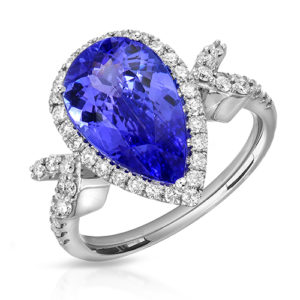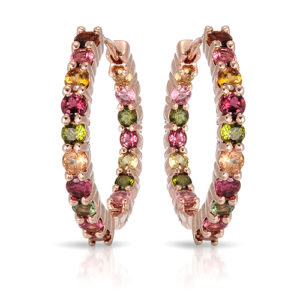
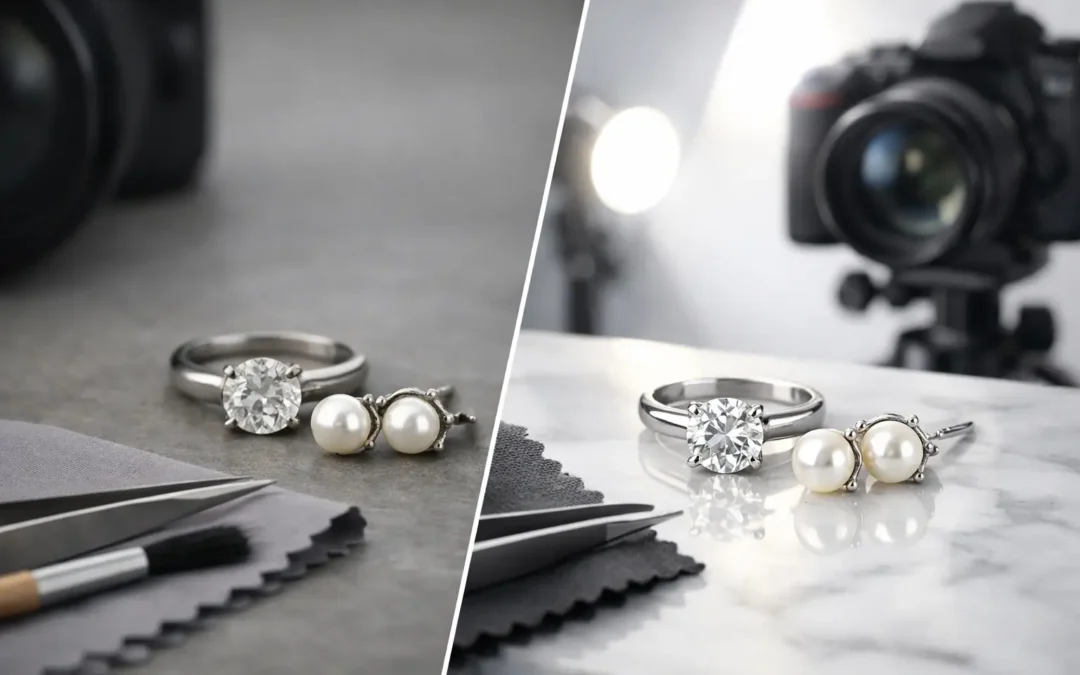
A diamond can look brilliant in a jewelry case and unexpectedly gray in a product photo. A polished gold ring can turn brown, while a richly colored gemstone loses the saturation that made it special. That is why jewelry photos look dull more often than sellers expect: jewelry does not create its own visual appeal in a camera. It reflects the environment, and every lighting, angle, surface, and retouching choice becomes visible on the final image.
The good news is that dull jewelry photography is usually a production problem, not a product problem. With jewelry-specific lighting and a disciplined shooting process, fine jewelry, commercial collections, loose stones, and watches can all look bright, dimensional, and accurate without being over-edited.
Why Jewelry Photos Look Dull in the First Place
Jewelry is one of the least forgiving products to photograph. It is small, reflective, and full of details that need to be visible at the same time: a diamond’s facets, a gemstone’s hue, a prong’s finish, an engraving, and the true color of the metal. A standard product-lighting setup may illuminate the piece, but illumination alone is not what creates a premium jewelry image.
A piece can be technically exposed and still appear lifeless. The camera may capture the jewelry clearly, yet without the highlights, contrast, edge definition, and controlled reflections that tell the eye it is looking at polished metal or a faceted stone.
Flat lighting removes shape and sparkle
The most common cause is overly broad, even lighting. Soft light is useful for controlling harsh reflections, but when it comes from only one direction or wraps around the entire piece without contrast, metal loses its contours. Diamonds and gemstones also lose the changing light patterns that make their cuts appear lively.
Jewelry needs intentional variation. We often use large soft sources to create clean metal surfaces, then add smaller, carefully placed accents to define edges, bring life into a stone, and separate the piece from the background. The goal is not to make every area equally bright. It is to make each important material read correctly.
Uncontrolled reflections make metal look dirty
Gold, platinum, silver, and polished steel act like small mirrors. They reflect the ceiling, camera, lens, studio walls, nearby equipment, and even the photographer. Dark bands in a ring shank or muddy patches across a pendant are often reflections, not defects in the jewelry.
This is why a quick light tent or a phone photo can make expensive pieces look less valuable. A controlled shooting environment uses white cards, black flags, diffusion, and precise light placement to shape reflections rather than simply hoping they disappear. White reflections define polished surfaces; darker controlled reflections can create depth. Both are needed, but both must be placed deliberately.
The angle is working against the piece
Jewelry has a best side, but it is rarely the most obvious one. A straight-on angle may hide a stone’s depth. A ring photographed too low can make the setting look heavy. A bracelet shot without support can flatten into an unrecognizable curve. Even a slight rotation can change whether a gemstone looks deep and luminous or dark and inactive.
The right camera angle depends on the item, its setting, and where it will be sold. A white-background catalog image needs immediate clarity at thumbnail size. A campaign image can use a more dramatic perspective. A detailed close-up may be needed to show pavé work, a halo setting, or an unusual clasp. Good photography considers these roles before the collection reaches the set.
Camera settings cannot compensate for poor lighting
Macro photography brings focus challenges. At close range, the depth of field becomes extremely narrow, meaning one edge of a ring may be sharp while the center stone or back prongs fall soft. Closing the aperture can help, but it also reduces available light and can introduce diffraction that softens fine detail.
For high-resolution jewelry work, the answer is usually a combination of stable support, precision focusing, and focus stacking when appropriate. Multiple images are captured with focus shifted through the piece, then blended to retain sharp detail across the product. It takes more time than a single exposure, but it can be essential for hero images, loose gemstones, and detailed luxury pieces.
Color and Exposure Can Make Jewelry Look Cheap
A dull image is not always a dark image. Sometimes it is an inaccurate image. Gold may become too yellow, rose gold may look coppery, and white metal can take on a blue or gray cast. Gemstones are equally sensitive. Emeralds can turn nearly black, pale aquamarines can wash out, and multicolor stones can lose the subtle tones that distinguish one piece from another.
Automatic white balance and generic editing presets are unreliable for jewelry. They respond to the overall scene, not to the commercial need for honest material color. Proper color management starts in the studio with neutral references, calibrated monitors, and lighting that is consistent from piece to piece. Retouching should then refine the image without changing what the customer will receive.
For diamonds, accuracy means balancing brilliance with detail. If highlights are pushed too far, facets clip to featureless white. If the image is underlit, the diamond goes gray and quiet. The best result shows a bright, crisp stone while preserving the pattern and structure of the cut.
How to Fix Dull Jewelry Photos Before They Reach Your Store
A reliable process prevents most problems before post-production. Start with a clean product. Dust, polishing compound, fingerprints, and loose fibers become highly visible under macro magnification, especially on polished metal and dark gemstones. Handle finished pieces with gloves whenever possible and inspect them closely before the first frame.
Next, build lighting around the material rather than using one setup for every product. A yellow-gold chain, a platinum engagement ring, a black-dial watch, and a translucent opal need different reflection control. Catalog efficiency matters, especially for large collections, but consistency should come from a repeatable system, not from forcing every item into an unsuitable setup.
Before a full production run, approve a sample image that establishes the collection standard. It should confirm the background, crop, metal color, degree of sparkle, shadow treatment, and retouching level. This is particularly valuable for manufacturers, wholesalers, and e-commerce sellers who need dozens or hundreds of images to look like they belong together.
A practical quality check should review these five areas before images go live:
- Metal surfaces should have clean, purposeful highlights rather than random dark reflections.
- Diamonds and gemstones should show color, facets, and brightness without blown-out white areas.
- The product silhouette and major details should remain sharp at the intended crop.
- White backgrounds should be truly clean while preserving natural edges and fine prongs.
- Images across a collection should match in scale, angle, brightness, and retouching style.
Retouching Should Refine the Jewelry, Not Redesign It
Professional jewelry retouching is where small distractions are removed and the photographed piece is polished to a commercial standard. This can include dust cleanup, reflection refinement, background cleanup, minor color correction, focus-stack blending, and careful enhancement of stone definition.
There is a line, however. Excessive retouching can create perfect but misleading jewelry. Removing every natural inclusion from a gemstone, altering metal color substantially, or adding sparkle that was never present can lead to disappointed customers and unnecessary returns. For e-commerce, the strongest image is visually appealing and credible.
In our Los Angeles studio, TN Connections approaches retouching as part of the photography process, not a rescue operation after a weak shoot. That distinction matters. When the raw capture has accurate color, clean reflection control, and strong focus, retouching can bring the image to a high-end finish while maintaining the integrity of the piece.
When a White Background Is Not Enough
White-background photography is essential for product pages, marketplaces, line sheets, and wholesale catalogs because it gives shoppers a clear, consistent view. But it is not designed to do every job. If a collection has a strong design story, texture, or emotional appeal, model imagery, hand shots, and creative lifestyle photographs can show scale and personality that a cutout cannot.
A practical asset mix often includes clean catalog angles for purchasing decisions and a smaller selection of campaign images for homepages, social media, advertising, and launches. For rings and earrings, hand or model photography can answer the scale question immediately. For watches, a short 360-degree video can reveal profile, dial depth, and metal finish more effectively than another still image.
The right mix depends on the sales channel and budget. A growing online catalog may need consistent, attractive images at volume, while a luxury launch may warrant more extensive art direction and detailed retouching. Qualifying volume catalog photography can start at $12 per image, while complex fine jewelry, creative sets, and model work require a custom production plan.
Get a Brighter, More Accurate Jewelry Catalog
If your jewelry looks dull in photos, do not assume the collection needs to be redesigned or the stones are not impressive enough. Most often, the image needs better reflection control, more intentional lighting, a stronger angle, and retouching that respects the product.
For brands in Downtown Los Angeles and the Los Angeles Jewelry District, an in-studio review can quickly identify what is flattening your images. For businesses elsewhere, nationwide mail-in photography makes the same specialized process available without sacrificing consistency. Request a free quote with a few sample pieces or existing images, and use the first approved setup to build a catalog that makes shoppers want to look closer.