A jewelry listing can lose a sale before a shopper reads a single bullet point. On Amazon, customers cannot feel the weight of a chain, inspect a clasp, or turn a diamond toward the light. Amazon jewelry photography has to answer those doubts visually: What does it really look like? How large is it? Is the color accurate? Does the finish look premium?
The direct answer is this: use clean, compliant main images to earn the click, then use detailed supporting images to prove quality, scale, and wearability. The best approach is not simply photographing jewelry on white. It is building a consistent image set that represents each piece honestly while making its strongest visual qualities easy to see.
What Amazon Jewelry Images Need to Accomplish
Amazon is a high-comparison environment. A shopper may open several nearly identical listings for gold hoops, engagement rings, tennis bracelets, or gemstone pendants. Price matters, but image quality often determines whether a product feels trustworthy enough to purchase.
A strong listing has two jobs. The main image must make the jewelry immediately recognizable at small thumbnail size. The remaining images must reduce hesitation by showing craftsmanship, dimensions, material detail, closure type, stone setting, and how the piece looks when worn.
This is especially important for jewelry because reflective metals and small gemstones are unforgiving. A poorly controlled highlight can make polished gold appear dull, turn silver gray, or hide the edges that define a setting. An overedited image can make a colored gemstone look unlike the product a buyer receives. Both issues can hurt conversion and create avoidable returns.
The main image earns the click
For most jewelry listings, the hero image should be a clear product-only view on a pure white background. It should show the complete item, be tightly framed without crowding the edges, and make the product the unmistakable focus.
The exact image rules can vary by category and change over time, so sellers should always confirm current Amazon requirements within their account and category guidance. From a production standpoint, the goal remains consistent: a crisp, accurate, distraction-free product image that reads quickly on mobile and desktop.
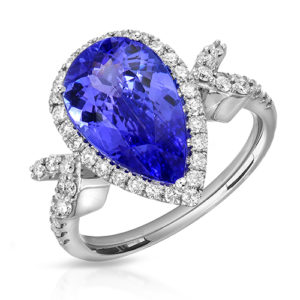
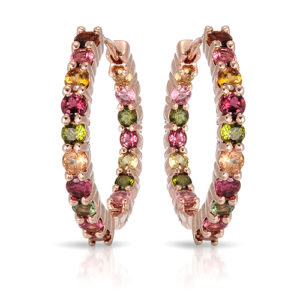
A ring may need a slightly elevated three-quarter angle to reveal both the center stone and shank. Earrings often require a straight-on view that makes the pair easy to understand. Necklaces need careful arrangement so the chain, pendant, and clasp do not appear tangled or distorted. There is no single angle that works for every piece.
The Amazon Jewelry Photography Image Set
Once the main image has done its job, supporting images should answer the questions a careful shopper asks before buying. For many listings, five to seven purposeful images are more valuable than a large group of repetitive angles.
| Image type | What it shows | Best use | |—|—|—| | White-background hero | Full product and overall silhouette | Main listing image | | Alternate angle | Depth, profile, setting, or construction | Rings, watches, dimensional pendants | | Macro detail | Prongs, pavé, engraving, texture, and stone facets | Fine jewelry and premium materials | | Scale image | Relative size and proportions | Studs, hoops, charms, pendants, bracelets | | On-model or hand-model image | Fit, drape, personality, and real-world scale | Necklaces, rings, earrings, bracelets | | Feature graphic | Materials, dimensions, care, or collection details | Supporting listing images where permitted | | Lifestyle image | Brand mood and aspirational use | Secondary content and brand storytelling |
The right mix depends on the product and the sales channel. A simple pair of commercial studs may need a hero shot, detail view, side profile, and ear-model image. A high-value sapphire ring may warrant additional macro photography that shows the stone’s color, setting workmanship, gallery, and band profile.
Do not use supporting images to repeat the same front-facing view. Every image should earn its place by communicating a new purchasing detail.
Lighting Diamonds, Gemstones, and Metal Correctly
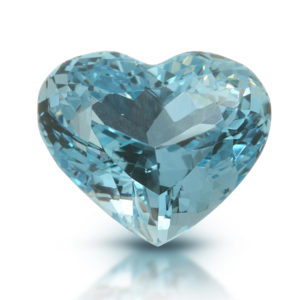
Jewelry lighting is a balancing act. Diamonds need controlled sparkle and visible facet definition, not random specular flare. Colored gemstones need enough directional light to reveal cut and life, but also balanced illumination that preserves their true hue. Metal needs clean highlights that describe shape without reflecting the camera, studio, or surrounding equipment.
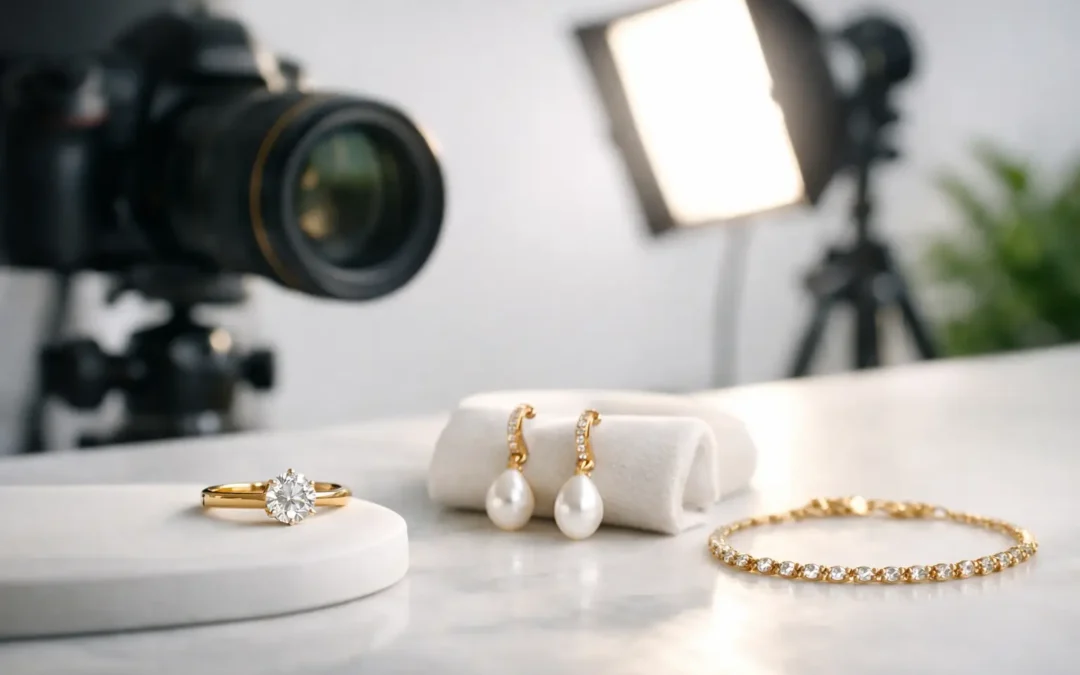
In our Los Angeles studio, we build lighting around the material rather than applying one setup to every product. A polished yellow-gold bracelet, a brushed platinum band, and an emerald pendant each react differently under light. The camera sees reflections that the eye may ignore, which is why jewelry-specific lighting and careful positioning matter so much.
For diamonds, overly diffuse light can remove the contrast that gives a stone visual energy. For gemstones, excessive brightness can wash out saturation or obscure natural inclusions. For highly reflective metal, broad and carefully placed light sources create clean, deliberate gradients that make the piece feel dimensional.
The goal is not to make every stone look artificially perfect. It is to show the jewelry at its best while accurately representing the product a customer will receive.
Retouching Should Refine, Not Misrepresent
Professional jewelry retouching is part of commercial product photography, not an afterthought. Dust, micro-scratches, fingerprints, loose fibers, and distracting reflections are common in high-resolution macro captures. Removing those temporary distractions creates a clean, premium presentation.
Retouching should also correct minor alignment issues, refine background edges, balance exposure, and keep a collection visually consistent. When a catalog includes 50 rings photographed over several production days, shoppers should not see obvious shifts in white balance, crop, shadow treatment, or metal color from one listing to the next.
There is a line between refinement and misrepresentation. Removing a speck of dust is appropriate. Changing a gemstone’s true color, fabricating diamond size, hiding permanent material characteristics, or altering proportions is not. Accurate representation protects your reputation and helps reduce the gap between customer expectation and delivered product.
Why Scale Images Matter So Much
Jewelry is one of the easiest products to misjudge online. A 6 mm hoop can look substantial in a close crop, while a bold pendant can appear smaller than expected without a model or dimensional reference. This is a frequent source of disappointed reviews and returns.
An on-model image gives shoppers immediate context. They can see where a necklace falls on the chest, how a bracelet sits on the wrist, or whether a ring has a delicate or statement-making presence. Hand-model photography is particularly effective for rings, stackable bands, charms, and bracelets because it communicates both scale and styling potential.
For brands that prefer a clean catalog look, a concise dimension graphic can work alongside a model image. The model creates emotional confidence; the measurement provides practical confirmation. Together, they make the listing easier to buy from.
Catalog Consistency Builds Brand Value
Consistency is not just an aesthetic preference. It makes a brand look organized, established, and dependable. When shoppers browse a storefront, mismatched backgrounds, erratic crops, inconsistent metal tones, and uneven shadow styles can make even good jewelry appear less valuable.
A documented visual standard helps prevent that. It can define the background treatment, camera angle, crop ratio, shadow style, color approach, file naming, and required views for each product type. This is especially useful for manufacturers, wholesalers, and growing e-commerce brands adding products every month.
If you already have a catalog style, new photography should match it closely. If your images have evolved over time, it may be worth creating a new standard and gradually updating best-selling listings first. The choice depends on catalog size, budget, and whether the current images still represent the quality of your product.
When to Use a Jewelry Photography Studio
DIY photography can be practical for quick social content or low-risk product tests. But it becomes difficult when products are highly reflective, stones are small, color must be exact, or a catalog needs to look uniform across hundreds of SKUs. The time spent managing lighting, focus stacking, file preparation, and retouching can quickly exceed the cost of professional production.
TN Connections Inc. specializes in jewelry photography for Amazon sellers, designers, wholesalers, and luxury brands. We photograph fine jewelry, diamonds, gemstones, watches, and commercial collections with white-background catalog photography, on-model imagery, detailed retouching, and 360-degree video options. Volume pricing can begin at $12 per image when applicable, making professional consistency accessible for recurring catalog work.
Local clients can work directly with us in Downtown Los Angeles near the Los Angeles Jewelry District. For brands elsewhere in the United States, our nationwide mail-in process makes it possible to send a collection securely, approve the visual direction, and receive high-resolution, marketplace-ready files without disrupting daily operations.
Before your next listing goes live, look at the images as a customer would: Can they see the quality, understand the size, and feel confident that the jewelry in the photo is the jewelry they will receive? If the answer is not immediate, request a free quote and build an image set that gives shoppers a clearer reason to choose your brand.