A valuable diamond ring, heirloom necklace, or one-of-a-kind sample should never be treated like an ordinary product shipment. So, can studios photograph insured jewelry? Yes, reputable jewelry photography studios can photograph insured jewelry, but the right process depends on your insurance policy, the value of the pieces, the studio’s security procedures, and clear documentation before the collection changes hands.
For luxury brands, designers, gemstone dealers, and growing e-commerce sellers, professional photography often means placing inventory outside the showroom or office for a short period. That does not have to be a risk you simply accept. It should be a managed handoff with defined responsibility, careful handling, and a production plan designed for valuable pieces.
Can Studios Photograph Insured Jewelry Under Your Policy?
Usually, yes, but do not assume that your existing policy automatically covers jewelry while it is at a photography studio, in transit, or handled by a third party. Coverage can vary based on whether the jewelry is personal property, business inventory, consignment stock, a prototype, or a loose diamond or gemstone.
Before scheduling a shoot, ask your insurance broker or carrier a direct question: is this jewelry covered while being transported to and held at a photography studio? Ask whether there are exclusions for shipping, unattended property, mysterious disappearance, off-premises inventory, or work performed by a vendor.
A professional studio should be equally direct about its own procedures. Insurance is one part of protection, but it is not a substitute for restricted access, secure storage, a documented intake process, and jewelry-specific handling. The goal is to prevent loss or damage in the first place, not merely establish what happens after an incident.
For higher-value collections, some clients may request a certificate of insurance, specific handling instructions, or an agreed inventory list before releasing their pieces. Those requests are reasonable. The more valuable or irreplaceable the item, the more detailed the handoff should be.
What a Jewelry Studio Should Have in Place
Jewelry photography is not handled like a typical apparel or consumer-goods shoot. Rings, fine chains, loose stones, watches, and delicate settings require controlled handling throughout styling, lighting, retouching review, and return shipping.
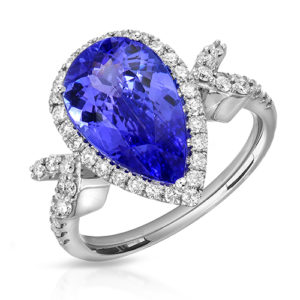
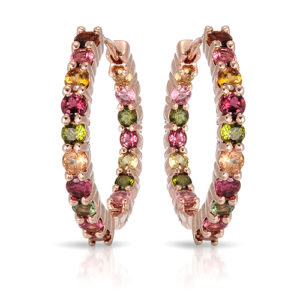
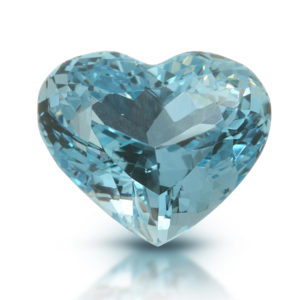
At TN Connections, jewelry is the central focus of our production process. In our Los Angeles studio, we work with fine jewelry, diamonds, colored gemstones, watches, designer collections, and commercial catalog inventory. That experience shapes practical details, from how pieces are staged for macro photography to how we track individual items across a multi-image project.
A studio handling insured jewelry should be prepared to discuss the following:
- A documented intake inventory that identifies each piece, its quantity, and any visible condition notes
- Secure, limited-access storage when jewelry is not actively being photographed
- Careful handling practices for soft metals, delicate prongs, pavé settings, pearls, enamel, and polished watch surfaces
- A defined return process, including shipping method, signature requirements, and shipment tracking
For a small collection, this may be a straightforward checklist and a few reference photos. For a manufacturer sending hundreds of SKUs or a luxury brand sending high-value samples, the process should be more structured. Item numbers, trays, image filenames, and return packaging should all align so the catalog remains organized from arrival through delivery.
Why Jewelry-Specific Handling Matters During Photography
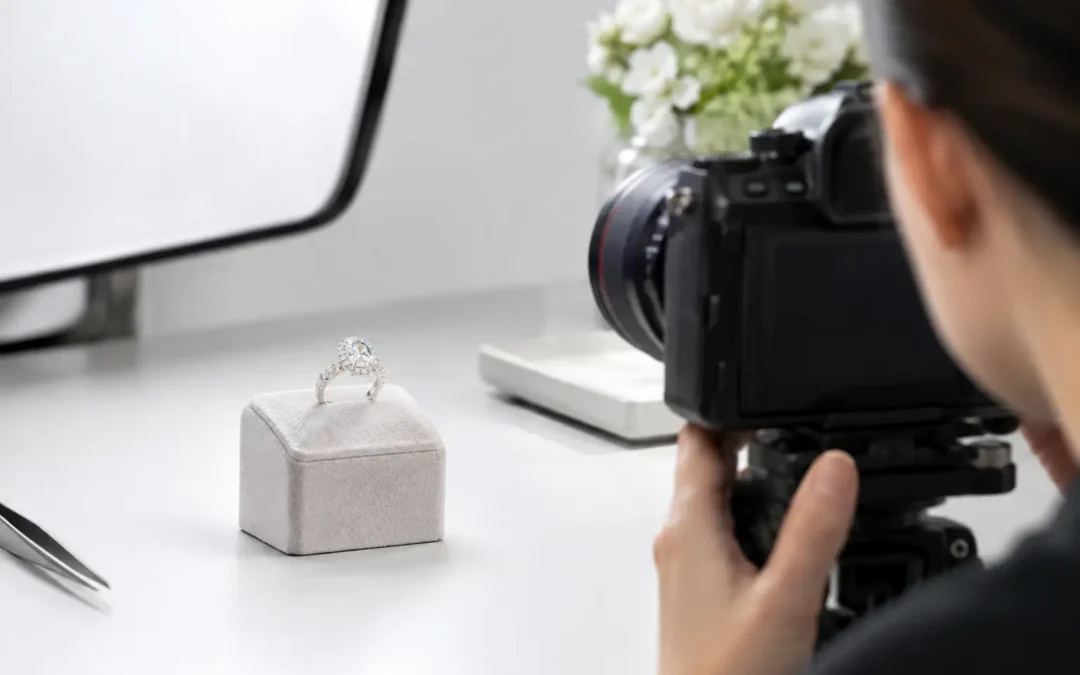
The studio environment itself affects risk. Jewelry photography involves frequent, precise adjustments. A ring may need to be rotated by a few degrees to show the center stone, an earring may need to be leveled to match the catalog, or a bracelet may require careful support to preserve its natural shape.
Those movements are necessary for quality, but they should be deliberate. A generic product studio may understand lighting, while a jewelry specialist understands why a polished gold surface can reflect every object in the room, why a diamond can look gray without proper light placement, and why a gemstone’s color needs controlled exposure rather than heavy editing.
Accurate photography also protects the commercial value of the product. Over-retouching can make a stone appear larger, clearer, or more saturated than it is. Poor lighting can make white gold look dull, turn yellow gold orange, or flatten the facets of a diamond. For insured jewelry, especially pieces sold online, the images need to be beautiful without misrepresenting the merchandise.
That is where specialized lighting and professional retouching matter. The final image should control distracting reflections, clean dust and minor presentation flaws, preserve metal texture, and show the piece at a useful scale. It should not alter a stone’s defining characteristics or disguise a condition issue that a buyer would reasonably expect to see.
Documentation Before the Shoot Protects Everyone
The most useful security tool is often the simplest: a complete, agreed record of what was sent. Before releasing insured jewelry to a studio, create an inventory that includes SKU or item name, quantity, a brief description, and reference images. For high-value pieces, include an appraisal reference or declared value where appropriate, but avoid sending unnecessary sensitive documents unless they are needed for insurance or shipping.
Take clear photos of each item before packing. Capture close-ups of identifying details such as engravings, distinctive inclusions, serial numbers, clasp styles, or unique stone arrangements. This is especially valuable for loose gemstones and similar-looking diamond jewelry.
When the studio receives the collection, the intake record should be reviewed against what arrived. If an item has a delicate area, such as a loose prong, damaged clasp, or fragile antique component, disclose it before production begins. Photography can be planned around known limitations, and no one has to guess about pre-existing condition concerns later.
For large-volume catalog work, organization has another benefit: it prevents costly product mix-ups. Consistent SKU tracking helps ensure that the right ring is paired with the right product page, correct gemstone details, and matching angles. This is as much an e-commerce quality-control issue as a security issue.
Shipping Insured Jewelry to a Studio
Nationwide mail-in jewelry photography can be practical and secure when the shipment is prepared correctly. The appropriate carrier and service level depend on the item value, your insurance requirements, destination, and timing. Your insurer may set specific limits or conditions, so verify those before choosing a shipping method.
Use discreet external packaging. Do not label a box with words that identify jewelry, diamonds, luxury goods, or the collection value. Inside, each piece should be protected from scratching, tangling, and movement. Rings, earrings, and loose stones should be separated and clearly labeled, while chains and bracelets should be secured to prevent knots or damage.
Signature confirmation and tracking are typically sensible for valuable shipments. Keep copies of the shipping receipt, tracking information, item inventory, and pre-shipment photos. If your collection is exceptionally valuable, discuss the shipment plan with both your insurance provider and the studio before sending it.
Local clients in Downtown Los Angeles and the Los Angeles Jewelry District may prefer to deliver pieces directly. An in-person drop-off can simplify the intake process and gives you an opportunity to review creative direction, sample angles, backgrounds, and timing face to face.
Set Expectations for Access, Timing, and Approval
There is a practical trade-off between speed and control. A studio can move quickly on a straightforward white-background catalog, but high-value pieces with extensive art direction, model photography, creative sets, or detailed retouching require more coordination. Confirm when your jewelry will be photographed, where it will be stored between setups, and when it will be returned.
For luxury launches, it is also wise to discuss confidentiality. Unreleased designs, custom commissions, and collection samples may require limited access and a clear understanding of who can view production files. If you need pre-launch images kept private, raise that requirement before the project begins rather than after content has been created.
Image approval is another point worth defining. Most brands benefit from reviewing an initial sample before the full collection is completed, particularly when matching an existing catalog. A sample confirms the metal tone, diamond brilliance, gemstone color, cropping, shadow style, and retouching level. It reduces revisions and helps protect consistency across the collection.
Questions to Ask Before You Book
A capable jewelry studio should answer practical questions without vague assurances. Ask how jewelry is inventoried on arrival, how pieces are stored when not on set, who has access during production, and how return shipping is documented. Ask whether the studio has experience with your product type, whether that is micro-pavé rings, loose emeralds, polished watches, or high-volume fashion jewelry.
You should also ask what the retouching includes. Clean, high-resolution images are expected, but the editing approach should preserve the authentic character of the jewelry. Confirm the number of angles, file specifications, turnaround expectations, and whether the studio can create white-background product images alongside on-model, lifestyle, banner, social media, or 360-degree video assets.
The best photography partner will not pressure you to use a one-size-fits-all process. A small independent designer may need a secure, affordable set of catalog images. A luxury house may need meticulous art direction, multiple lighting treatments, and a detailed chain of custody. Both deserve careful production.
If you are preparing an insured collection for photography, request a quote with the number of pieces, product types, desired image styles, delivery deadline, and any special insurance or handling requirements. A clear conversation before shipment helps your jewelry arrive ready to sparkle, photograph accurately, and return with confidence.