A diamond can look flat, gray, or overly white in a photograph even when it is exceptional in person. A vivid sapphire can shift too dark, too purple, or too saturated. That is why diamond and gemstone photography is not simply macro photography with a brighter light. It is a controlled process of showing a stone’s cut, color, transparency, and character while preserving the confidence shoppers need to make a purchase.
For jewelry brands, gemstone dealers, designers, and online sellers, the goal is not to make every stone look artificially perfect. The goal is to make each piece look desirable, accurate, and consistent with the collection around it. The best image gives a buyer enough visual information to appreciate the stone without creating surprises when the jewelry arrives.
What Diamond and Gemstone Photography Must Show
Every stone reacts to light differently. Diamonds return sharp flashes of white light and spectral fire. Emeralds often need restrained lighting to retain their rich green body color. Opals need an angle that reveals play-of-color without turning their surface into a bright reflection. Pearls need soft, broad highlights that describe their luster rather than a hard specular spot.
A strong product image balances three things: brilliance, accurate color, and readable form. Push brilliance too far and a diamond loses its facet definition in blown-out white areas. Prioritize color alone and the image can feel lifeless. Show too much texture or contrast and a stone may appear less refined than it does to the eye.
This balance also depends on the sales channel. A high-jewelry campaign image can use mood, selective shadow, and dramatic direction. A white-background catalog image needs clarity and repeatability first. For a loose-stone dealer, accurate color, cut, and inclusion visibility may matter more than a theatrical sparkle effect. The right approach depends on what a customer needs to evaluate before buying.
Lighting Diamonds Without Losing Their Facets
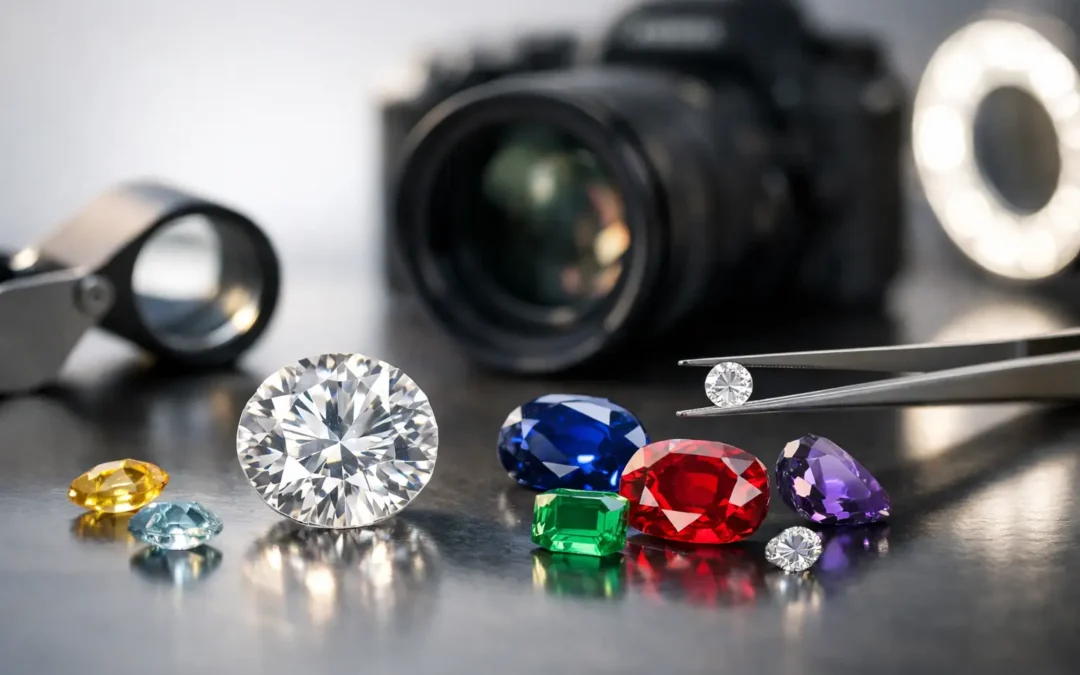
Diamonds are challenging because they reflect almost everything around them, including the camera, the studio, and the photographer. Their visual appeal comes from a combination of brilliance, fire, scintillation, and crisp facet edges. One light rarely produces all of those qualities at once.
In our Los Angeles studio, we build light around the individual piece. Broad, diffused sources establish a clean overall exposure and help define the diamond’s shape. More directional, carefully positioned light introduces controlled flashes and separates facet planes. Small changes in camera height or the angle of a ring can dramatically change where that sparkle appears.
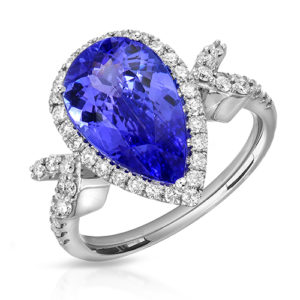
The metal setting matters just as much. Highly polished platinum, white gold, and yellow gold can create bright reflections that compete with the center stone. Prongs may cast shadows across a diamond, while a halo setting can create clutter if every small stone reflects at maximum intensity. We control those reflections so the center stone remains the visual priority and the metal still looks smooth, dimensional, and premium.
For round diamonds, a straight-on view often works well for catalogs because it clearly shows symmetry and the setting. Fancy shapes require more judgment. An oval can look narrow or overly elongated depending on perspective. A pear shape needs an angle that keeps its point crisp. An emerald-cut diamond benefits from lighting that reveals its step facets instead of turning the center into a dark window.
Photographing Gemstones With Accurate Color
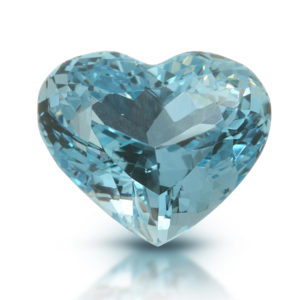
Color is often the deciding factor in gemstone sales, which makes faithful reproduction essential. A ruby, sapphire, tourmaline, spinel, or aquamarine can look different under daylight, warm LED light, and studio flash. Camera settings, monitor calibration, background influence, and retouching choices all affect the final result.
The first priority is establishing a believable base capture. We assess the stone’s dominant hue, tonal depth, saturation, transparency, and secondary colors before deciding on the lighting direction. A lighter stone may need a darker controlled reflection to show its outline. A deeply saturated stone may need more lift around the crown or side facets so it does not photograph as a nearly black shape.
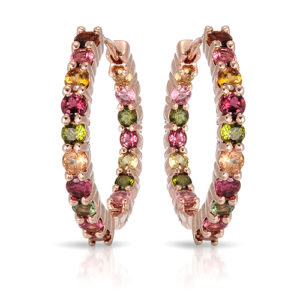
Some stones also have natural traits that should be visible. Jardin in emeralds, silk in sapphires, color zoning in tourmalines, and internal patterning in opals can be part of a gem’s identity. Retouching should remove distracting dust, temporary marks, and lighting artifacts. It should not erase a stone’s natural character or make a commercial gemstone appear to be a different grade.
Color accuracy has practical limits because every buyer views images on a different screen. A professional workflow can greatly reduce unwanted shifts, but it cannot guarantee that an uncalibrated phone display will match a calibrated monitor exactly. For valuable or color-sensitive stones, multiple angles and a close-up detail image give customers a more reliable understanding than one heavily edited hero shot.
Angles That Help Customers Understand the Piece
A single front-facing image is rarely enough for fine jewelry. It may show the gemstone beautifully while hiding a raised setting, a detailed gallery, or the actual scale of a pendant. The right image set answers the questions a buyer would ask when holding the piece.
For rings, that usually means a top view, a three-quarter hero angle, and a side profile that shows the setting height and under-gallery. Earrings benefit from a matched pair image plus an angled detail that reveals stones and metalwork. Pendants need a view that explains their thickness, bail, and chain relationship. Loose gems commonly need face-up, profile, and angled macro views.
Model and hand-model photography can add the missing sense of proportion. It is particularly valuable for statement rings, gemstone earrings, layered necklaces, and pieces with unusual scale. White-background images do the essential selling work, while model imagery helps shoppers imagine ownership and gives a collection more personality.
Why Consistency Matters More Than One Perfect Image
A jewelry website is judged as a collection. If one diamond ring is bright and cool, the next is dark and warm, and the third has a different crop or shadow style, shoppers may question the products or the brand. Consistent photography makes a catalog easier to browse and makes pricing feel more credible.
Consistency starts before the first exposure. The camera position, lens choice, background treatment, crop, jewelry orientation, and lighting recipe should be defined for the collection. Retouching standards need the same discipline. Metal color, background white point, stone saturation, and shadow density should be reviewed across the full group, not image by image in isolation.
This does not mean every piece should look identical. A vivid emerald should still look different from a pale morganite, and a black diamond should retain its darker character. Catalog consistency means the visual treatment is stable enough that the product differences are clear and believable.
For growing brands and high-volume sellers, a repeatable setup also protects budget and turnaround. Once an approved look is established, future launches can be photographed to match it. That is often more valuable than creating a new visual style for every shipment.
Retouching That Supports Trust
Professional jewelry retouching is where a well-lit capture becomes a finished sales image. It can clean dust from gemstones, smooth distracting metal reflections, correct minor color casts, refine backgrounds, align matched earrings, and remove supports or temporary holding materials. At a luxury level, it can also involve detailed work on prongs, pavé, chain links, engraving, and complex reflections.
The trade-off is restraint. Excessive retouching can make diamonds look pasted in, metal look plastic, and gems look unnaturally fluorescent. Fine jewelry customers are perceptive. They expect polish, but they also expect the piece they receive to resemble the piece they selected.
A good retouched image preserves sharp edges where they belong, maintains natural transitions in polished metal, and keeps the stone’s internal structure believable. It should look clean, not manipulated.
A Production Plan for Brands and Sellers
Before sending a collection for photography, decide where the images will appear and which products deserve extra coverage. An Amazon listing, wholesale line sheet, luxury e-commerce site, and social campaign do not all need the same number of images or level of art direction.
For a catalog refresh, clean white-background angles and consistent crops may be the priority. For a new fine-jewelry launch, the plan might include detailed product images, hand-model photography, creative campaign frames, website banners, and short 360-degree videos. For loose diamonds and gemstones, close inspection views and color-faithful lighting are usually central.
TN Connections Inc. photographs diamonds, gemstones, fine jewelry, and commercial jewelry from the Downtown Los Angeles Jewelry District, with nationwide mail-in service for brands that cannot visit in person. We can match an existing catalog style or help establish a visual system that supports future releases, with volume pricing available when the project fits a repeatable workflow.
If your collection needs images that make the stones look as considered online as they do under the counter lights, request a free quote and include a few sample pieces, your desired sales channels, and any existing catalog references. A clear production plan is the best way to protect both visual quality and budget.