A shopper cannot feel the weight of a gold chain, turn a ring toward the light, or inspect a gemstone in person. E-commerce jewelry photography has to do that visual work quickly: show the piece clearly, make its materials believable, and give a buyer enough confidence to add it to the cart.
That requires more than placing jewelry on a white background. Diamonds can go dark under the wrong light. Polished metals mirror every light source and camera surface. Gemstones can shift color, and a beautifully made piece can look flat if the angle does not reveal its proportions. Strong product photography controls these variables while keeping the collection consistent from product page to product page.
What E-Commerce Jewelry Photography Must Accomplish
The primary job is accuracy with appeal. Images should show the actual color, finish, stone detail, setting, clasp, and scale of a product without making it look clinical or over-edited. A customer should recognize the piece when it arrives, while still seeing it at its best online.
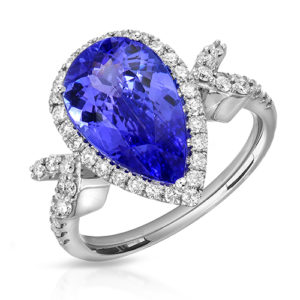
For a fine jewelry brand, that may mean carefully shaped highlights on a platinum ring and enough diamond sparkle to show the stone’s life without blowing out facets. For a high-volume catalog, the goal may be clean, repeatable white-background images that keep hundreds of SKUs visually organized and ready for a website, marketplace, or wholesale line sheet.
The right approach depends on where and how you sell. A luxury launch benefits from more art direction and detail imagery. A marketplace seller may need standardized front, side, back, and close-up views that meet listing requirements and can be produced efficiently. Both need lighting designed specifically for jewelry.
Lighting Jewelry Is a Reflection Problem
Jewelry photography is often described as macro photography, but macro capability alone is not the answer. The real challenge is controlling reflection. Gold, silver, platinum, polished steel, and gemstones all react differently to light.
A broad light source can create smooth, elegant gradients across metal. Smaller, carefully placed lights can add controlled sparkle to diamonds or define the facets of a colored stone. The goal is not to make every surface equally bright. It is to give the piece dimension, preserve texture, and keep the metal from looking gray, black, or covered in distracting reflections.
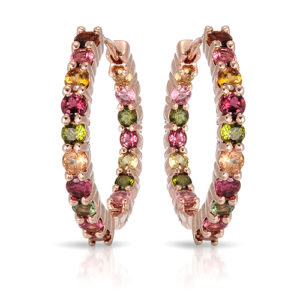
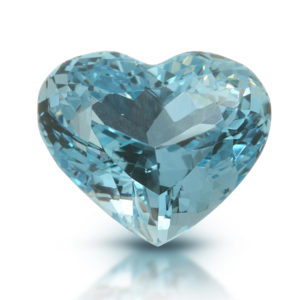
Gemstones require special attention. An emerald needs color accuracy and a view that does not hide its internal character. A diamond needs crisp facets and brightness while retaining the outline of the setting. Pearls need soft light that reveals luster instead of harsh glare. Each material calls for a different lighting balance, which is why a one-light setup or a generic product-photo preset rarely produces dependable results.
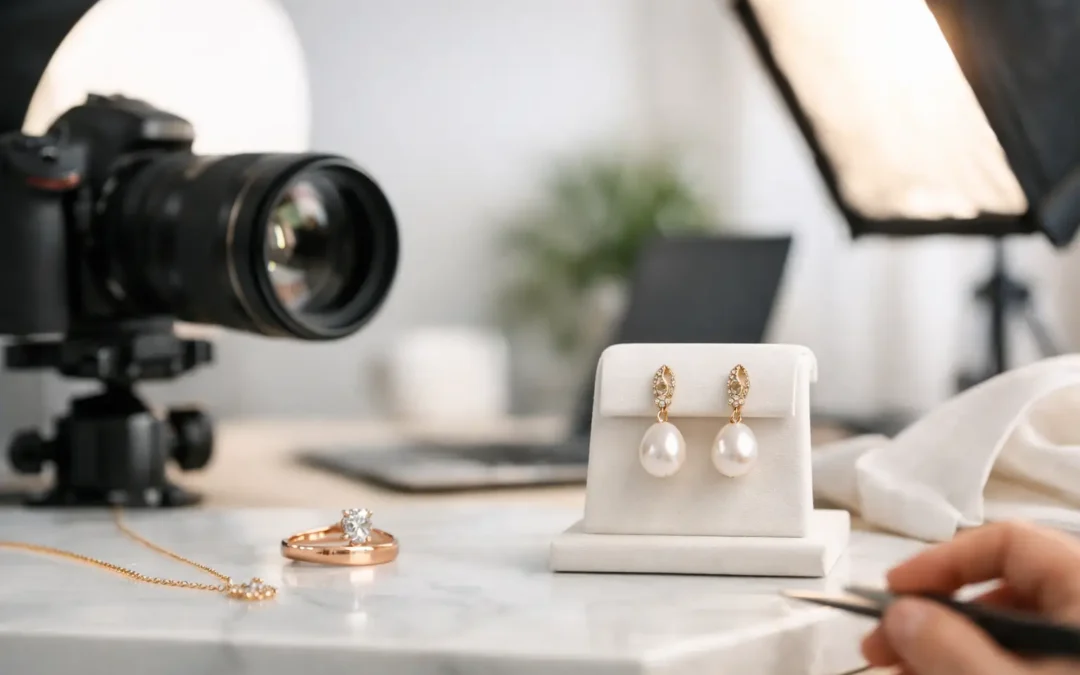
In our Los Angeles studio, we build lighting around the individual product and then document the setup for catalog consistency. That process is especially valuable for collections photographed over multiple production days or for brands that add new styles throughout the year.
Choose the Right Image Mix for Each Sales Channel
White-background product images remain the foundation of most jewelry e-commerce sites. They load cleanly into online stores, marketplaces, inventory systems, print materials, and advertisements. But white background alone does not always answer every buying question.
A practical assortment combines clean catalog photography with detail, scale, and brand-building images where they help the sale.
| Image type | Best use | What it helps customers understand | |—|—|—| | White-background product image | Product pages, marketplaces, catalogs | Design, color, setting, and overall shape | | Detail macro | Fine jewelry, stones, craftsmanship | Facets, pavé work, engraving, prongs, texture | | On-model or hand-model image | Rings, bracelets, earrings, necklaces | Proportion, fit, personality, and scale | | Lifestyle or creative campaign image | Launches, social campaigns, banners | Brand mood and aspirational value | | 360-degree jewelry video | Premium pieces and complex designs | Movement, depth, profile, and reflective surfaces |
A simple pair of stud earrings may only need a polished hero image, alternate angle, close-up, and model view. A statement engagement ring may warrant additional profiles, a gallery view, close stone detail, and a 360-degree video. More images are not automatically better. Each one should answer a useful question or help the product stand apart.
Angles That Reduce Buyer Hesitation
The hero image should make the item easy to identify in a search grid. It needs a clean silhouette, intentional framing, and a consistent scale relative to the rest of the catalog. That is the image most likely to earn the click.
Once a customer reaches the product page, alternate views take over. A side profile shows the height of a ring setting. A back view clarifies an earring closure. A clasp image reassures a customer buying a necklace or bracelet. A close-up can establish the quality of an engraving, stone setting, or textured finish.
Scale is another frequent gap. Jewelry can look much larger or smaller than expected when photographed in isolation. Measurements in the product description are necessary, but a hand-model or on-model image makes dimensions immediate. For pieces such as hoops, tennis bracelets, stacking rings, and pendants, that context often matters as much as the catalog image.
Retouching Should Refine, Not Invent
Professional retouching is where a properly photographed piece becomes sales-ready. It removes dust, fingerprints, loose fibers, minor surface distractions, and unwanted reflections that even a careful studio setup cannot always avoid. It can also refine backgrounds, align color across a collection, and ensure every image is cropped consistently.
Retouching should not change a product into something it is not. Over-whitened diamonds lose natural definition. Excessively smoothed metal can look synthetic. Gemstone color pushed too far can create customer disappointment and unnecessary returns. The standard should be truthful enhancement: the jewelry is clean, luminous, and accurately represented.
For established brands, matching an existing visual standard is equally important. A new collection should not appear as if it came from a different store because the background tone, crop, reflection style, or metal color has changed. Before production, a jewelry specialist should review reference images and define the approved look.
Plan the Shoot Before You Send the Collection
A smoother photo project starts with a clear shot list. Identify SKU numbers, product categories, requested angles, background needs, whether models are required, and the final image uses. This avoids a common and costly problem: realizing after delivery that a marketplace needs a different crop or a product page needs a missing side view.
Jewelry should arrive clean, labeled, and organized by SKU whenever possible. If a collection includes matching sets, note the relationships clearly. For valuable diamonds, gemstones, watches, or one-of-a-kind pieces, confirm handling, shipping, insurance, and approval procedures before the project begins.
A useful production plan also distinguishes between catalog assets and campaign assets. Catalog images should be repeatable and efficient. Campaign images can be more expressive, using creative lighting, props, models, or environment to create a distinctive brand world. Trying to make every SKU image a campaign image usually slows production and weakens catalog consistency.
When Volume Pricing Makes Sense
Cost is shaped by the number of products, requested angles, complexity of the jewelry, retouching level, and whether models or video are involved. A single diamond ring photographed from multiple angles with detailed retouching requires a different production plan than 300 pairs of earrings on a standardized white background.
For recurring collections and larger catalogs, an established system improves both price and turnaround. Once the lighting, crop, angles, and retouching standards are approved, production moves faster without sacrificing the appearance of the collection. TN Connections offers qualifying volume pricing starting at $12 per image when the project and deliverables fit a streamlined catalog workflow.
That does not mean every project should be treated as volume work. High-value pieces, complex stones, reflective watches, and luxury campaigns deserve the time needed for meticulous lighting and finishing. The value comes from choosing the production level that supports your merchandise and sales channel rather than paying for a one-size-fits-all package.
Work With a Jewelry-Specific Studio
A general product studio may be able to photograph a box, bottle, or handbag well. Jewelry asks for a more specialized process because its materials reveal every lighting decision. The studio should understand how to preserve diamond brilliance, control metal reflections, represent gemstones faithfully, and maintain a unified look across a full catalog.
For Los Angeles clients, working from the Downtown Los Angeles Jewelry District makes it easy to review samples, discuss art direction, and bring collections directly to the studio. Nationwide brands can use a mail-in process with clear shot lists, pre-production communication, and image approvals.
Before booking, ask to see comparable work: not just one dramatic hero shot, but rings, chains, earrings, gemstones, watches, white-background catalogs, and on-model images. A strong portfolio reveals whether the photographer can handle both precision and consistency.
Ready to make your products look as valuable online as they do in person? Request a free quote with your SKU count, desired views, and intended sales channels. The best place to begin is a defined visual standard that your next collection, and the one after that, can confidently follow.