A ring can be perfectly made and still look disappointing online. One stray reflection can turn polished gold gray, a tiny speck of dust can distract from a diamond, and an inaccurate gemstone color can create hesitation before a customer ever reaches the product description. Jewelry retouching is the process of refining those photographic details so the final image looks clean, dimensional, and true to the piece.
For jewelry brands, the goal is not to make a product look artificial. It is to remove the visual noise that camera sensors, macro lenses, and reflective materials reveal, while protecting the details a buyer needs to see. Done well, retouching supports confidence, catalog consistency, and a more premium shopping experience.
What Jewelry Retouching Should Accomplish
High-resolution jewelry photography captures far more than the eye notices at first glance. It records dust, fingerprints, faint scratches, mounting wax, uneven reflections, thread marks, and tiny imperfections that may be invisible in normal handling. At macro scale, those distractions can make even a luxury piece appear poorly finished.
Professional jewelry retouching corrects those issues while preserving the character of the item. The setting should still look like a setting, pavé diamonds should retain their individual structure, and polished metal should have believable highlights rather than a flat, plastic finish. The image needs to feel refined, not overworked.
This distinction matters especially for online jewelry. Shoppers cannot pick up a pendant, inspect the clasp, or turn a gemstone under the light. Your image has to communicate finish, material, craftsmanship, and scale in a few seconds. When every product image follows the same visual standard, a collection feels more established and easier to trust.
The Details That Need the Most Attention
Jewelry is among the most demanding product categories to retouch because every material reacts differently under light. Gold, silver, platinum, diamonds, pearls, and colored stones cannot be treated with one generic editing recipe.
Metal reflections must look controlled, not erased
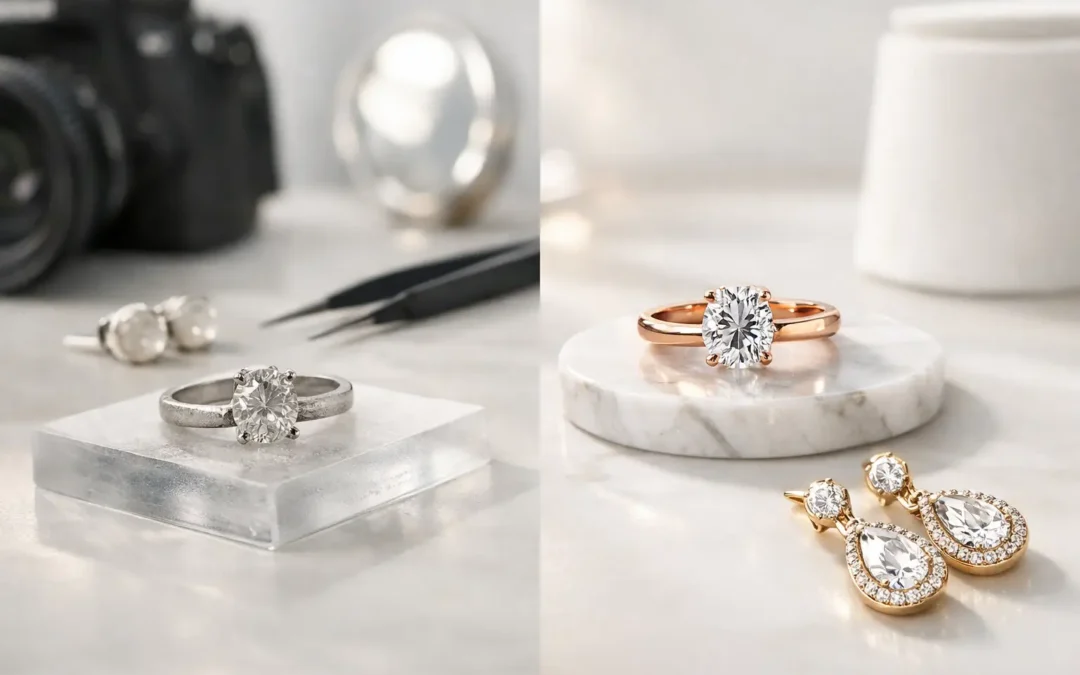
Highly polished metal reflects everything around it, including cameras, light modifiers, studio surfaces, and even the room itself. Retouching removes unwanted dark bands and distracting shapes while maintaining a realistic gradient across the surface. A completely white or perfectly uniform metal area often looks flat and loses the form of the piece.
Yellow gold also needs careful color control. Too much warmth can make it look orange; too little can make it appear pale or silver. Rose gold is equally sensitive, since a minor shift in color can change the perceived alloy. The right result depends on the actual material, the brand’s established catalog look, and the intended sales channel.
Diamonds need brilliance and honest detail
A diamond should sparkle, but it should not look pasted onto the setting. Retouchers balance brightness, contrast, facet definition, and fire without manufacturing an unrealistic stone. The best result lets shoppers see the diamond as a dimensional object with crisp edges and believable light behavior.
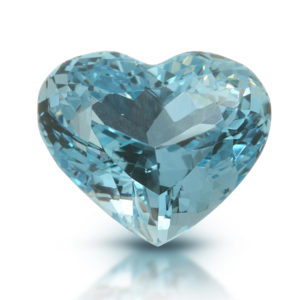
For diamond and gemstone dealers, accuracy matters even more. Over-enhancing a loose stone can lead to customer disappointment when the piece arrives. We aim to show the stone at its best under controlled photography, not create a version of it that does not exist.
Gemstone color needs a disciplined approach
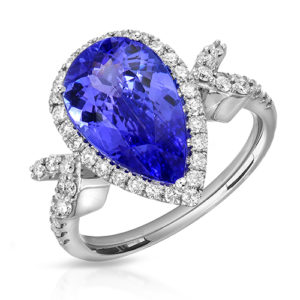
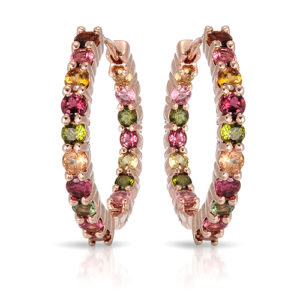
Colored stones are affected by lighting, surrounding metal, white balance, and monitor settings. Emeralds, sapphires, rubies, opals, tourmalines, and tanzanites all require individual attention. A cooler reflection can make a blue sapphire appear gray; an overly saturated edit can make a natural emerald look synthetic.
Retouching can improve clarity and remove distracting reflections, but it should not misrepresent hue, transparency, inclusions, or treatment-related characteristics. For commercial jewelry, a pleasing and consistent appearance is often the priority. For rare stones, one-of-a-kind fine jewelry, and dealer inventory, fidelity should lead the decision.
What Is Usually Included in Professional Retouching?
The exact scope depends on the item, image use, and level of finish required. A high-volume white-background catalog image may need efficient cleanup and consistent color. A hero image for a luxury launch may require more extensive hand work to perfect reflections, stone detail, and composition.
A complete jewelry retouching workflow commonly includes:
- Dust, fingerprint, lint, and scratch removal
- Reflection cleanup on polished metal and stones
- Color, exposure, and white-balance correction
- Edge refinement around prongs, chains, clasps, and bezels
- Background cleanup or pure-white background preparation
- Alignment, cropping, and scale consistency across a catalog
- Selective enhancement of diamond and gemstone detail
- Removal of temporary supports, wires, putty, or mounting materials
Not every image should receive every treatment. An antique piece may need its patina preserved. A brushed-metal watch should retain its original texture. An intentionally dark, dramatic campaign image should not be pushed toward a bright e-commerce style. Good retouching follows the art direction and purpose of the image.
Jewelry Retouching for Different Sales Channels
The same ring may need different final files for a Shopify product page, an Amazon listing, a printed lookbook, and an Instagram campaign. Retouching should account for where customers will see the work.
| Image use | Retouching priority | Best visual approach | | — | — | — | | E-commerce product page | Accuracy and consistency | Clean background, repeatable angle, realistic color | | Marketplace listing | Clarity at small sizes | Bright product separation, simple crop, minimal distractions | | Luxury campaign | Mood and craftsmanship | Detailed hand retouching, controlled reflections, art-directed color | | Wholesale catalog | Speed and uniformity | Consistent crop, background, exposure, and file naming | | Social media | Immediate visual impact | Strong focal point, polished finish, channel-specific crop |
For a growing brand with hundreds of SKUs, consistency often produces a bigger return than elaborate retouching on a handful of images. For a luxury collection with a smaller number of important pieces, a more detailed finishing process may be the right investment. The best choice depends on your product value, volume, launch timeline, and the expectations of your customer.
Why Retouching Starts Before the Edit
Retouching can solve many problems, but it should not be used to compensate for poor jewelry photography. If lighting is wrong, metal edges disappear, stones lack structure, or the camera angle hides key design details, editing becomes slower and less convincing.
In our Los Angeles studio, we build the lighting around the specific jewelry rather than forcing every piece into one setup. A diamond eternity band requires different light control than a high-polish signet ring. A delicate chain needs careful handling to avoid tangles and uneven curves. A large gemstone needs lighting that reveals color and cut without creating overpowering glare.
This photography-first approach keeps retouching efficient and gives the final image more believable depth. It is also what helps maintain consistent quality when photographing a full collection over multiple production days.
Common Retouching Mistakes That Cost Sales
The most common mistake is over-retouching. When every reflection is removed, the metal can look like gray paint. When diamonds are excessively whitened, they lose facet definition. When gemstones are boosted too far, shoppers may question whether the product photo is accurate.
Another problem is inconsistent finishing across the catalog. A customer comparing three necklaces should not see one image with bright white metal, another with warm yellow metal, and a third with a gray background. Those differences make an online store feel less polished, even when the jewelry itself is strong.
Finally, avoid using one generic edit for every product. Fine jewelry often benefits from a refined, dimensional finish. Fashion jewelry may need bright, efficient catalog treatment. A heritage brand may prefer softer highlights and a less clinical appearance. Retouching should reinforce the brand, not overwrite it.
A Better Workflow for Jewelry Brands
Before production begins, define how the images will be used and select a reference look. This can be an existing product page, a campaign image, or a sample style created for the new collection. Establishing these decisions early prevents costly revisions once a large catalog is already in progress.
For recurring photography, document the preferred background, crop, metal tone, shadow treatment, file dimensions, and required angles. That creates a repeatable standard whether you are adding ten pieces or launching a 500-SKU catalog. It also makes future images easier to match with existing inventory.
TN Connections provides jewelry photography and high-resolution retouching for luxury brands, independent designers, wholesalers, and e-commerce sellers. From the Downtown Los Angeles Jewelry District, we work with local clients directly and support nationwide mail-in projects for collections that need reliable handling, clear communication, and consistent results. Volume pricing can start at $12 per image when the project is a fit.
If your current jewelry photos are technically clean but still do not feel premium, the missing detail may be in the finishing. Request a free quote with your product count, intended use, and a few sample pieces, then build a retouching standard that gives every item its strongest honest presentation.