A diamond can fill an entire product frame and still leave a shopper asking the most basic question: how large is it? Can photography show carat size? Not with certainty. Photography can communicate apparent size, proportions, and presence exceptionally well, but carat weight is a physical measurement that an image alone cannot prove.
For jewelry brands, that distinction matters. A beautiful image should make a stone look its best without creating a surprise when the piece arrives. The strongest product pages pair precise photography with clear carat-weight and millimeter details, then use scale imagery to make those specifications easy to understand.
What photography can show about carat size
A carefully photographed ring, pendant, or loose stone can give viewers a reliable sense of how substantial it appears. The camera can reveal face-up spread, meaning the visible width and length of the gemstone; how much of the stone sits above the setting; and how the design reads on a hand, neck, or ear.
That is often what shoppers mean when they ask about carat size. They are not always looking for a gemological verification. They want to know whether a 1-carat center stone will look delicate, balanced, or bold on their hand. Photography is highly effective at answering that visual question when it is produced with scale in mind.
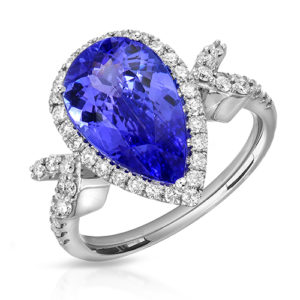
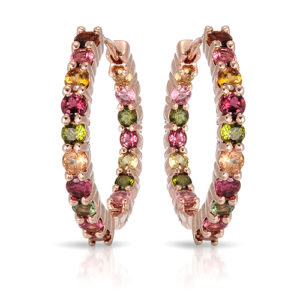
A white-background hero image is excellent for showing cutting, sparkle, metal finish, and silhouette. A hand-model image adds context. A close macro crop can show facets and craftsmanship that would disappear in a wider shot. Each image has a different job, and none should be treated as a substitute for the product specifications.
Why a photo cannot verify a stone’s carat weight
Carat is a unit of weight, not a measurement of visible diameter. One carat equals 0.2 grams, but two stones with the same carat weight can look noticeably different from the top. Their dimensions depend on shape, cutting proportions, depth, and girdle thickness.
A deep-cut diamond carries more of its weight below the girdle and may face up smaller than a shallower stone of equal weight. An oval, pear, marquise, or emerald cut can appear larger than a round diamond at the same carat weight because of its elongated outline or larger visible surface area. Colored gemstones introduce even more variation because different minerals have different densities.
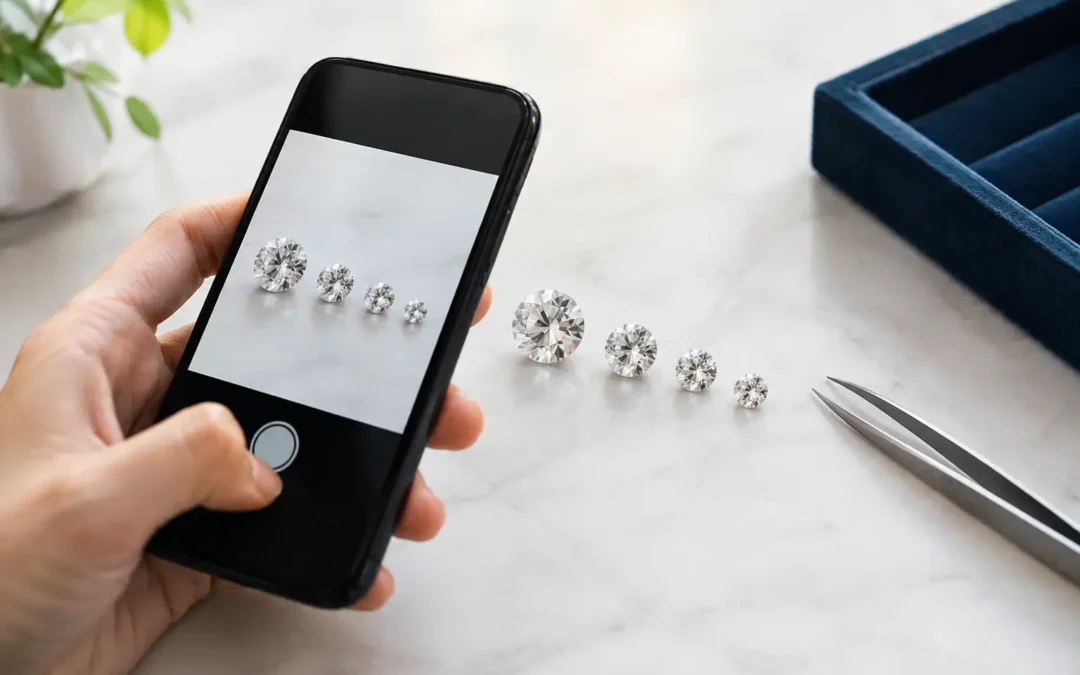
Camera technique can add another layer of distortion. A macro lens, close focusing distance, selective crop, and viewing angle can make a small stone feel dramatic. That is useful for showing craftsmanship, but it cannot answer the question of exact carat weight. Even a photograph with a ruler beside the stone only indicates dimensions, not weight.
For this reason, brands should state carat weight in product copy and, where relevant, include dimensions in millimeters. For important diamonds and loose stones, certification details should be presented separately and accurately. Photography supports trust when it illustrates those facts rather than asking shoppers to infer them.
The images that communicate scale honestly
The most effective jewelry catalog does not rely on one image to carry every selling point. It uses a planned set of views that answers the customer’s likely questions before they need to ask.
| Image Type | What It Communicates | Best Use |
|---|---|---|
| White-background front view | Overall design and face-up appearance | Product listings and catalogs |
| Side or profile view | Height, setting depth, and stone placement | Rings, raised settings, earrings |
| Hand or model image | Wearable scale and personality | Engagement rings, bracelets, necklaces |
| Detail macro | Facets, prongs, engraving, and finish | Luxury pages and social content |
| Dimension graphic or reference view | Exact measurements in context | Technical product pages |
For a ring, a hand-model image is usually the most persuasive scale reference because it shows the relationship between the center stone, band width, and finger. It should still be handled thoughtfully. Finger size varies, so a model image offers context, not an absolute promise. Including the model’s ring size can be useful for larger-ticket pieces.
For earrings and pendants, a straightforward on-model image works particularly well. It shows drop length, stud diameter, and how a necklace sits at the collarbone. A product photographed only in isolation may look larger or smaller than a buyer expects, especially on a mobile screen.
Lighting changes perceived size more than most sellers expect
The way a stone is lit can make it feel larger, sharper, or more brilliant. Broad, controlled light can define a gemstone’s outline and preserve clean facet detail. More directional sparkle light creates flashes that bring diamonds to life. The work is balancing both without blowing out the table, hiding inclusions that should remain visible, or turning metal into a field of distracting reflections.
In our Los Angeles studio, we use jewelry-specific lighting to separate the stone from the setting while controlling reflections across polished gold, platinum, and silver. This helps a diamond retain its actual outline rather than becoming a white, overexposed spot. It also allows colored gemstones to show hue and saturation without pushing their color beyond what the buyer will reasonably see.
Retouching plays a role, too. Professional retouching can remove dust, fibers, fingerprints, and temporary surface distractions. It can refine inconsistent metal reflections and create a clean, premium background. It should not alter the stone’s dimensions, fabricate brilliance, or make a modest center stone appear materially larger than it is. For e-commerce, that boundary protects both conversion and return rates.
How to photograph carat size without misleading customers
Start with the product information. Record total carat weight, center-stone weight when applicable, stone dimensions, metal type, ring size, and chain length or earring dimensions. If a piece includes many small diamonds, make it clear whether the listed number is total carat weight rather than the weight of one stone.
Then choose the image plan based on the sales channel. Marketplace listings benefit from clean, consistent white-background views and visible proportions. A designer’s direct-to-consumer site may also need hand-model imagery, close details, and campaign assets that build desire. Luxury brands often require additional art direction, but the factual scale information remains just as essential.
Keep camera angles consistent across a collection. When every ring is photographed at a different distance or crop, shoppers cannot compare sizes from one product page to the next. Catalog consistency is especially valuable for wholesalers, manufacturers, and brands with recurring releases. The visual system should make a 0.50-carat ring, a 1-carat ring, and a 2-carat ring feel comparable at a glance without forcing identical crops where the design calls for a different view.
Avoid using a hand image with no corresponding product image. The model shot sells the experience, while the clean catalog view lets shoppers inspect the item. Together, they provide both emotional appeal and practical clarity.
A better product-page formula for diamonds and gemstones
For most fine-jewelry listings, use a polished primary image, a profile view, at least one scale image, and accurate written specifications. If the setting or stone quality warrants it, add a high-resolution macro and a 360-degree jewelry video.
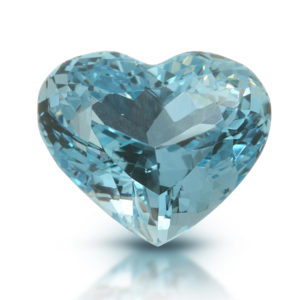
Video is particularly useful because it reveals how a stone catches light as the piece turns. It does not establish carat weight either, but it can reduce uncertainty about depth, profile, metal finish, and overall presence. For loose gemstones, a rotating video also gives buyers a better look at facet pattern, transparency, and color movement than a single still frame.
The right mix depends on price point and audience. A high-value engagement ring deserves more visual proof than a basic fashion stud, while a large commercial catalog needs a repeatable production process that remains affordable. TN Connections photographs both luxury collections requiring detailed art direction and high-volume e-commerce catalogs that need clean, attractive consistency, with volume pricing available when applicable.
Common questions about photography and carat size
Can a photo make a diamond look bigger than it is?
Yes. Tight crops, macro lenses, angles, bright reflections, and a lack of familiar reference points can all increase perceived size. This is why a scale image and clear millimeter dimensions are so valuable alongside the hero shot.
Is millimeter size more helpful than carat weight in a photograph?
Often, yes. Carat weight tells buyers about mass, while millimeter measurements help them understand visible dimensions. Providing both is the clearest approach, particularly for fancy-shaped diamonds and colored gemstones.
Should every jewelry listing include a model image?
Not necessarily. It is most valuable for rings, earrings, necklaces, bracelets, and any piece where fit or apparent size affects the purchase decision. For loose stones and simple catalog inventory, consistent product views plus dimensions may be the better production choice.
A photograph should create desire, but it should also make the buyer feel secure enough to act. When your images show real visual scale and your product data supplies the exact measurements, shoppers can appreciate the brilliance of the piece without guessing what will arrive. If your current catalog makes size difficult to judge, request a free quote for a jewelry photography plan built around clarity, consistency, and the level of polish your collection deserves.