A necklace can look exceptional from the front and still lose a sale when the shopper cannot see how it fastens. Necklace clasp photography answers a practical buying question: Is this closure secure, refined, easy to use, and consistent with the quality promised by the rest of the piece? For fine jewelry, that small detail can be the difference between an admired product page and a completed order.
For e-commerce catalogs, a clasp image is not usually the hero image. It is supporting proof. It reassures customers about craftsmanship, helps them understand the full construction of the necklace, and reduces uncertainty before checkout. The right photograph makes the clasp look intentional rather than hidden, oversized, scratched, or difficult to operate.
Why clasp images matter in jewelry e-commerce
A necklace clasp carries more commercial weight than its size suggests. Shoppers use it to judge durability, material quality, ease of wear, and whether the necklace will work with their routine. A customer buying a fine gold chain wants to see a clean spring ring, lobster clasp, box clasp, or magnetic closure before committing. A customer considering a pearl strand may specifically want to inspect the safety catch and the finishing near the clasp.
Clasp photography is especially valuable when the closure is a design feature. Pavé-set clasps, engraved barrel clasps, hidden clasps, toggle closures, and gemstone-set findings deserve the same care as the pendant or central stone. If the clasp is distinctive, treating it as an afterthought leaves product value on the table.
For commercial jewelry catalogs, clear closure images also help prevent avoidable returns. A close-up can show whether an extender is included, how long it is, where it attaches, and whether the chain has a recognizable adjustment system. Those details set accurate expectations without requiring a customer to contact your team.
The best angles for necklace clasp photography
The best angle depends on the clasp style and what buyers need to understand. Most necklaces do not require a dozen closure photos. They need two or three precise, consistent views that answer the question quickly.
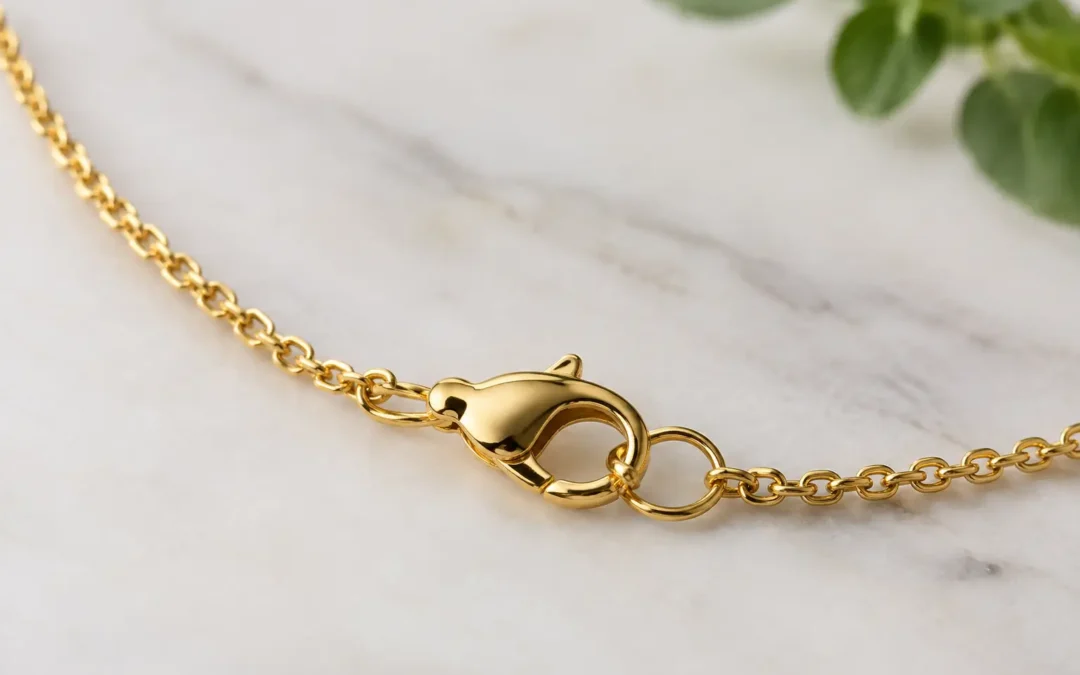
A straight-on macro view is usually the foundation. It shows surface finish, metal color, branding, stones, and the overall condition of the closure. This is the image that must look polished enough to stand beside high-resolution product photography of the necklace itself.
A slightly angled view adds depth. It is often the better choice for lobster clasps, spring rings, and box clasps because it reveals the mechanism and the relationship between the clasp, jump ring, and chain. Without this perspective, reflective metal can flatten into an unhelpful shape.
An open-clasp image is useful when operation is a selling point or when the closure is not immediately obvious. It should be used selectively. For an everyday chain, one carefully styled open view may be enough. For a premium bracelet or necklace with a safety lock, an open and closed view can give buyers confidence that the mechanism is secure.
A full-length back or flat-lay image puts the closure in context. This view helps customers see extender chains, logo tags, and the position of the clasp relative to a pendant. It is particularly helpful for marketplace listings, where buyers often compare construction details before purchasing.
Lighting metal without losing the mechanism
Clasp photography is a lighting problem before it is a camera problem. Polished gold, silver, platinum, rhodium, and vermeil can reflect every surface in the studio. A direct light may create a bright hotspot that hides the release lever or makes the metal look cheap and uneven. Insufficient directional control can make the same clasp appear gray and lifeless.
In our Los Angeles studio, we use jewelry-specific lighting control to shape reflections rather than simply brighten the object. The goal is to create clean highlight lines that describe the form of the clasp while preserving enough shadow to show how it functions. This is especially important in macro work, where a mark too small to notice in person can become distracting on screen.
Gold needs accurate warmth without turning overly yellow. Silver and white metals need contrast so they do not disappear into a white background. Black rhodium and oxidized finishes need carefully placed highlights that define their edges while retaining their intended depth. When gemstones are set into the clasp, lighting must support both the metal finish and the stone’s brilliance.
The background should serve the sales channel. White-background images are usually the right choice for catalog pages, Amazon, wholesale line sheets, and product comparison pages. A controlled dark or tonal background can work for luxury campaign assets, but only when it remains consistent with the collection’s art direction and does not conceal functional details.
Scale, focus, and color accuracy
A clasp close-up should be large enough to inspect but not so magnified that it creates a misleading impression of size. This is a frequent issue with macro photography. A tiny spring ring can look substantial when photographed at extreme magnification, while a substantial box clasp can look smaller than expected if it is shown only from a distance.
The strongest approach combines a detail shot with one contextual image. The close-up communicates finish and construction; the full product image communicates proportion. If the clasp has an extender or a special locking mechanism, a simple caption in the product listing can complete the explanation.
Focus stacking may be necessary for intricate clasps. At close range, depth of field becomes very narrow, and a single exposure may leave the front edge sharp while the rest of the mechanism falls soft. When appropriate, multiple focused captures can be combined to produce a naturally sharp final image. This should still look realistic, not artificially crisp or overly processed.
Color accuracy matters just as much. Rose gold, yellow gold, and white gold need to remain differentiated across an entire catalog. A customer should not see one necklace photographed with a pale yellow finish and another with a deep orange cast if they are made from the same metal. Consistent capture and professional retouching protect that accuracy.
Retouching that preserves credibility
Professional retouching should improve a clasp image without changing what the customer will receive. We remove distracting dust, fingerprints, minor temporary blemishes, and unwanted reflections. We can refine the background, balance metal tones, and ensure the closure looks clean at web resolution and in high-resolution use.
What retouching should not do is invent a different product. Deep scratches, obvious plating wear, missing stones, misaligned components, or material defects should be addressed in production when possible. For brands photographing sample pieces, the right decision depends on whether the photographed item accurately represents the final sellable product. Honest imagery protects customer trust and reduces complaints later.
Catalog consistency is equally important. Every clasp image should follow the same crop logic, background treatment, metal color standard, and level of retouching. This matters for a luxury collection with meticulous art direction, but it also matters for a growing seller uploading hundreds of SKUs. Consistency makes a catalog feel more established and makes products easier to compare.
When a clasp deserves extra production attention
Some closures merit a more detailed shot list because they influence the perceived value or usability of the piece. Consider extra coverage for:
- Hidden, box, or safety clasps that need open and closed views
- Diamond, gemstone, pavé, or engraved clasps that function as decorative elements
- Magnetic closures, toggles, and specialty mechanisms that buyers may question
- Adjustable chains, multi-length necklaces, and extenders that affect fit
- Vintage, estate, or one-of-a-kind jewelry where condition and construction matter
For a simple commercial cable chain, a clean back view and one close-up may be sufficient. For a luxury tennis necklace or pearl strand, the clasp may deserve its own polished product image and a supporting video frame. The right scope depends on the product’s price point, sales channel, and the questions your buyers are most likely to ask.
Building clasp images into a complete necklace shot list
Clasp photography works best as part of a defined product-image system, not as an isolated request after a shoot. For a typical e-commerce necklace, the core set may include a front hero image, full-length view, pendant or centerpiece detail, on-model image for scale, and one closure image. A more premium collection may add styled campaign photography, hand-model imagery, and 360-degree video.
For marketplace sellers and high-volume catalogs, repeatability is the priority. Establish a standard clasp angle, crop, and background once, then apply it across future drops. This keeps production efficient and supports qualifying volume pricing without sacrificing the clean, attractive presentation shoppers expect.
TN Connections photographs necklaces, clasps, chains, and complete jewelry collections from the Downtown Los Angeles Jewelry District, with nationwide mail-in service for brands that need a specialized jewelry production partner. Whether you are launching fine jewelry or refreshing a large commercial catalog, request a free quote with your product count, clasp styles, preferred image use, and turnaround needs.
A well-photographed clasp tells customers that no part of the jewelry was overlooked. Give that detail the same discipline as the stone, the setting, and the hero shot, and it will quietly strengthen every product page it supports.