A jewelry listing has only a few seconds to answer the buyer’s biggest questions: Is the metal really that polished? Does the stone have life? How large is it? Can I trust this seller? Photographing jewelry for marketplaces is not simply about making a ring look bright. It is about making the piece clear, desirable, and credible on a small screen.
For most marketplace listings, the strongest approach is a consistent set of clean white-background product images, supported by close-up details and at least one scale image when appropriate. Luxury pieces may also need carefully directed lifestyle, hand-model, or video content, but the core catalog image still has to do the hard work. It must show the product accurately while making the craftsmanship feel worth the price.
What marketplace jewelry photos need to accomplish
Jewelry is one of the most demanding products to photograph because it is small, reflective, and often defined by subtle details. A flat-looking diamond, gray-looking gold, or inaccurate gemstone color can create hesitation before a shopper ever reads the description.
A successful image set gives the buyer enough visual information to make a decision without handling the piece. That means controlling metal reflections, preserving the actual color of gemstones, showing texture and setting details, and selecting angles that reveal construction rather than hide it. For a wholesale catalog, this also means repeating the same standard across hundreds of SKUs.
Marketplace photography has a commercial job as well. A strong main image earns the click. Detail images reduce uncertainty. Scale and on-model images help prevent returns caused by size expectations. Consistent photography makes an entire storefront look more established, whether you are launching 20 handmade pieces or maintaining a large manufacturer catalog.
Start with a main image that reads instantly
The primary image should be simple. In most marketplace categories, a clean white background is the safest and most versatile starting point. It makes the piece easy to compare, keeps attention on the product, and can be repurposed across brand websites, retailer portals, line sheets, and marketplaces.
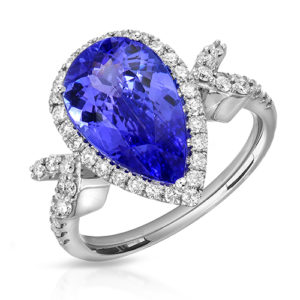
Simple does not mean careless. White background jewelry photography requires precise separation between the jewelry and the background. White gold, platinum, silver, and pavé diamonds can disappear into poorly managed lighting. Yellow gold can turn overly orange. High-polish surfaces can reflect the camera, studio, or dark edges of the set.
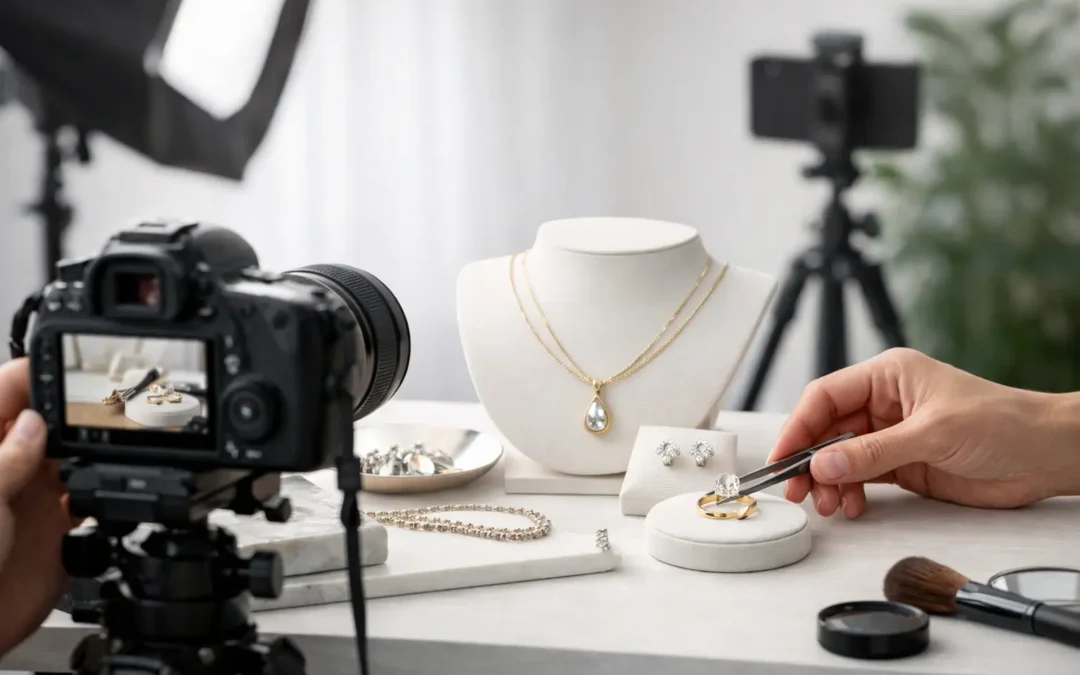
In our Los Angeles studio, we build lighting around the specific material rather than applying one preset to every piece. A polished gold bangle needs broad, controlled reflections that define its curves. A diamond engagement ring needs lighting that preserves both the metal shape and the stone’s brilliance. A textured designer pendant may need more directional light so its finish remains visible.
The main image should generally show the jewelry at its most recognizable angle. For a ring, that is often a three-quarter view that shows the center stone, setting profile, and band. For earrings, buyers need a view that makes the pair, closure, and drop length easy to understand. Necklaces require a carefully shaped chain and pendant placement, not a loose tangle that looks accidental.
Build the right image set for the product
One image rarely answers every buying question. The number of images should reflect the product’s price, complexity, and selling channel. A simple pair of studs may need three polished views. A fine jewelry ring with a premium center stone may deserve six or more, including macro details and a hand-model image.
| Image type | What it answers for the shopper | Best use | |—|—|—| | White-background hero image | What is the product? | Main marketplace listing image | | Alternate angle | What does the side, back, or profile look like? | Rings, earrings, clasps, settings | | Macro detail | What is the craftsmanship or stone quality? | Diamonds, gemstones, engraving, pavé | | Scale image | How large will it look when worn? | Earrings, necklaces, bracelets, rings | | On-model or hand-model image | How does it fit into a real look? | Premium collections and fashion-led designs | | 360-degree video | How does it catch light from every side? | High-ticket jewelry, watches, statement pieces |
The goal is not to fill every listing with images for the sake of it. Use a fuller set when additional angles answer meaningful questions. For lower-priced commercial jewelry or high-volume catalog work, a consistent front, angle, and detail view may be the most efficient balance of cost and conversion value.
Show scale without misleading the buyer
Scale is one of the most common reasons shoppers feel disappointed after delivery. Product dimensions in the listing are necessary, but they are not always easy to visualize. A hand-model image can show how a ring sits on the finger, while worn earrings communicate length far better than a number alone.
Scale images need restraint. They should accurately represent the piece without using dramatic cropping, forced perspective, or oversized props. For gemstone jewelry, the model image also helps buyers see how color performs against skin tone and in a natural context. The white-background image remains the factual catalog record; the model image adds human understanding.
Light diamonds, gemstones, and metals differently
The biggest technical mistake in jewelry photography is treating every reflective surface the same way. Jewelry-specific lighting is less about adding more light and more about placing controlled reflections exactly where the piece needs definition.
Diamonds need a balance of brilliance, fire, and facet definition. Too much diffuse lighting can make a diamond look soft and milky. Too much point-source sparkle can obscure the cut and make the image feel artificial. The ideal result shows life in the stone while keeping its shape believable.
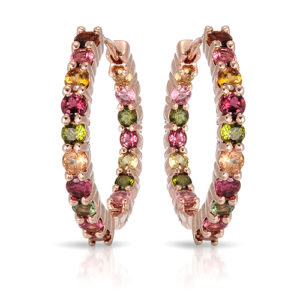
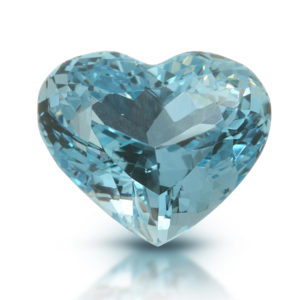
Colored gemstones require even more care. Sapphire, emerald, ruby, opal, tourmaline, and other stones can shift dramatically under different lighting. A photograph should be attractive, but it must remain an honest representation of the stone’s hue, saturation, transparency, and inclusions. Heavy editing that changes a stone’s essential color may produce clicks, but it also produces disputes and returns.
Metals present their own challenge. Gold is reflective, so its visual form comes from the reflections around it. Platinum and white gold require clean edge definition to avoid looking dull or disappearing against white. Rose gold needs color correction that retains its warmth without becoming pink or coppery. Professional retouching can remove distracting dust and minor surface marks, but it should not erase the material character that makes the piece real.
Keep your catalog consistent as inventory grows
Consistency is a sales tool. When each listing has a different crop, shadow, background tone, or color treatment, shoppers may assume the products come from different sources or that the brand lacks quality control. This is especially damaging for fine jewelry collections, where presentation is part of perceived value.
Set standards before the shoot begins: background treatment, image dimensions, crop ratios, product orientation, file naming, and required angles. A manufacturer or wholesaler may need a repeatable production template for thousands of products. A luxury designer may need a more art-directed system that still maintains consistency across a collection.
This is also where a studio’s retouching process matters. Retouching should remove lint, fingerprints, mounting materials, scratches created during handling, and visual distractions. It can refine edges and improve polish while keeping prongs, stone inclusions, engravings, and proportions truthful. The finished image should look like the jewelry on its best day, not like a different product.
Choose white background, creative, or model photography based on the channel
White-background photography is the foundation for marketplace selling because it is clean, efficient, and easy to use across channels. It is the right first investment for Amazon sellers, Etsy shops building a cohesive catalog, wholesalers supplying retailer-ready images, and brands improving a product detail page.
Creative and lifestyle photography has a different role. It establishes mood, differentiates a collection, and gives social media and campaign assets more personality. It is especially useful for designer launches, holiday gifting, bridal collections, and high-end pieces that benefit from visual storytelling. It should complement the catalog images, not replace them.
Model photography is best when fit, scale, styling, and aspiration contribute to the sale. For a delicate necklace or a ring stack, a model can communicate proportion and help shoppers imagine ownership. For a loose gemstone or a wholesale component catalog, clean detail photography is usually more valuable than a styled scene.
Prepare jewelry before it reaches the camera
Even excellent retouching is more efficient when the pieces arrive clean and organized. Inspect each item for fingerprints, dust, loose tags, protective film, and tangled chains. Include a shot list with SKUs, metal colors, stone details, and any required views. If pieces are part of sets, label that clearly.
For nationwide mail-in projects, organized inventory prevents unnecessary delays and helps maintain catalog accuracy. For local clients, working directly with a specialized studio in the Los Angeles Jewelry District makes it easier to review samples, discuss art direction, and establish a repeatable standard for future production.
TN Connections photographs fine jewelry, diamonds, gemstones, watches, designer collections, and high-volume commercial catalogs with jewelry-specific lighting and high-resolution retouching. Whether you need a premium launch campaign or a practical catalog system with volume pricing when applicable, request a free quote with your SKU count, desired angles, and delivery timeline.
The best marketplace images do not ask shoppers to imagine the product. They let the jewelry show its quality clearly enough that the next click feels like a confident purchase.